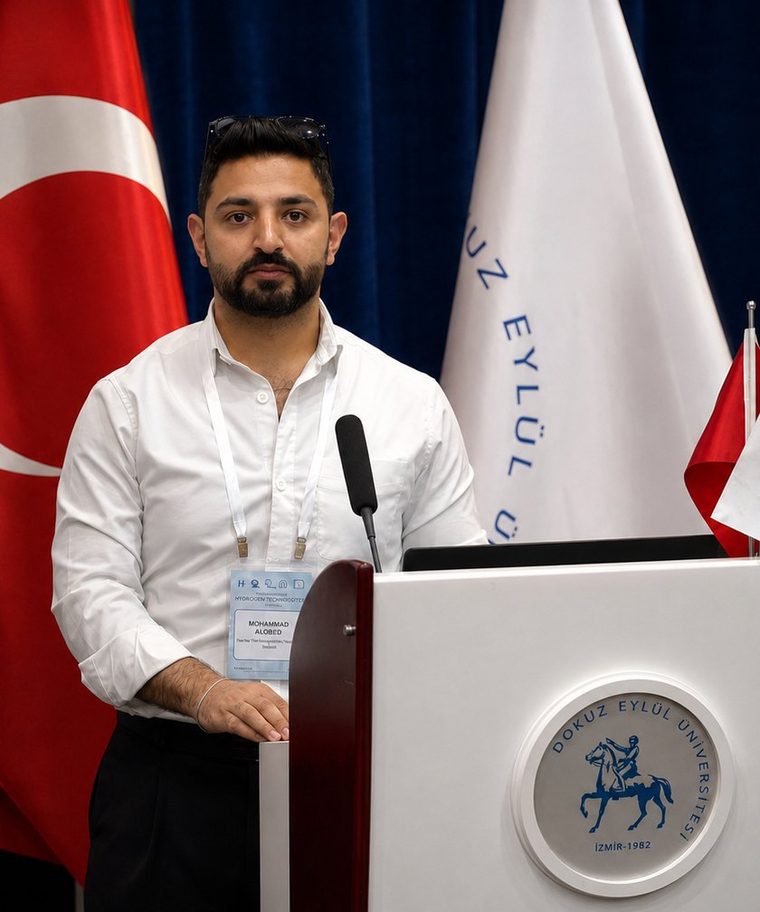
Dr. Mohammad Alobeid
Hydrogen energy researcher and modelling and simulation engineer
Specialising in green hydrogen technologies, fuel cells, electrolysers and advanced numerical simulation.
Introduction
Mechanical engineer, researcher and consultant
I am a mechanical engineer, researcher, and modelling and simulation consultant specialising in green hydrogen technologies and electrochemical energy systems.
My research and engineering work focuses on hydrogen fuel cells, water electrolysers, advanced energy systems and computational modelling, with particular experience in PEM fuel cells, PEM water electrolysers, solid oxide fuel cells, solid oxide electrolysis cells and direct methanol fuel cells.
Alongside my research in hydrogen and electrochemical energy systems, I specialise in CFD and multiphysics simulation, using advanced numerical tools to model, analyse and optimise complex engineering systems.
- Tools
- ANSYS Fluent, ANSYS Workbench, ANSYS SpaceClaim and COMSOL Multiphysics. The models are validated against experimental data.
Education
Academic background
- Mechanical engineering
- PEM electrolyser
- Hydrogen & fuel cells
- CFD of fuel cell systems
I earned my bachelor's degree in mechanical engineering from the University of Bahrain, followed by a master's degree at Ankara Yıldırım Beyazıt University, where my research focused on PEM water electrolysers.
I am currently pursuing my PhD at Ankara Yıldırım Beyazıt University, with research focused on hydrogen technologies and fuel cell systems, including PEM fuel cells and advanced electrochemical energy systems.
My doctoral research focuses particularly on CFD modelling and optimisation of PEM fuel cell systems for heavy-duty transportation applications.
Expertise
Research and technical expertise
The domain and the simulation work belong together: the modelling exists to answer questions about hydrogen and electrochemical energy systems.
Hydrogen and electrochemical energy systems
- Green hydrogen technologies
- PEM water electrolysers
- PEM fuel cells
- Solid oxide fuel cells (SOFCs)
- Solid oxide electrolysis cells (SOECs)
- Direct methanol fuel cells (DMFCs)
- Electrochemical energy systems
- Hydrogen energy applications
- Fuel cell system development and optimisation
Modelling, simulation and engineering analysis
- Computational Fluid Dynamics (CFD)
- Multiphysics modelling
- ANSYS Fluent
- ANSYS Workbench
- ANSYS SpaceClaim
- CFD meshing and model development
- Heat and mass transfer
- Multiphase flow modelling
- Species transport and electrochemical modelling
- Numerical simulation and optimisation
- Engineering data analysis and post-processing
Consulting
Modelling and simulation consultant
In addition to my academic research, I work as a modelling and simulation consultant, providing technical support in numerical modelling, CFD, multiphysics simulation and engineering analysis.
My consulting work focuses particularly on applying advanced simulation methods to hydrogen technologies, fuel cells, electrolysers and complex engineering systems.
This work involves developing simulation models, selecting appropriate physical and numerical approaches, analysing results, and using computational tools to support engineering design and optimisation.
Current position
Hydrogen technologies and energy applications
At the Hydrogen Technologies and Energy Applications Research Center (H2team), I lead the Modelling and Simulation Department, where I work on computational modelling, numerical simulation and engineering analysis for hydrogen and electrochemical energy systems.
My work combines research, simulation, system development and technical consulting, with a particular focus on using computational methods to understand and optimise advanced hydrogen technologies.
Current research
PEM fuel cells for heavy-duty transport
My current research focuses on the development and optimisation of PEM fuel cell systems for heavy-duty transportation applications.
The work involves advanced CFD modelling, electrochemical analysis, thermal and fluid-flow management, and system-level optimisation, supported by experimental data.
The objective is to understand the interaction between fluid flow, heat and mass transfer, electrochemical processes and system operating conditions, in order to improve fuel cell performance and reliability.
Selected publications
Research and publications
My research spans computational modelling, hydrogen technologies, advanced energy systems and fluid-flow simulation. These papers apply numerical and computational methods to real engineering problems.
-
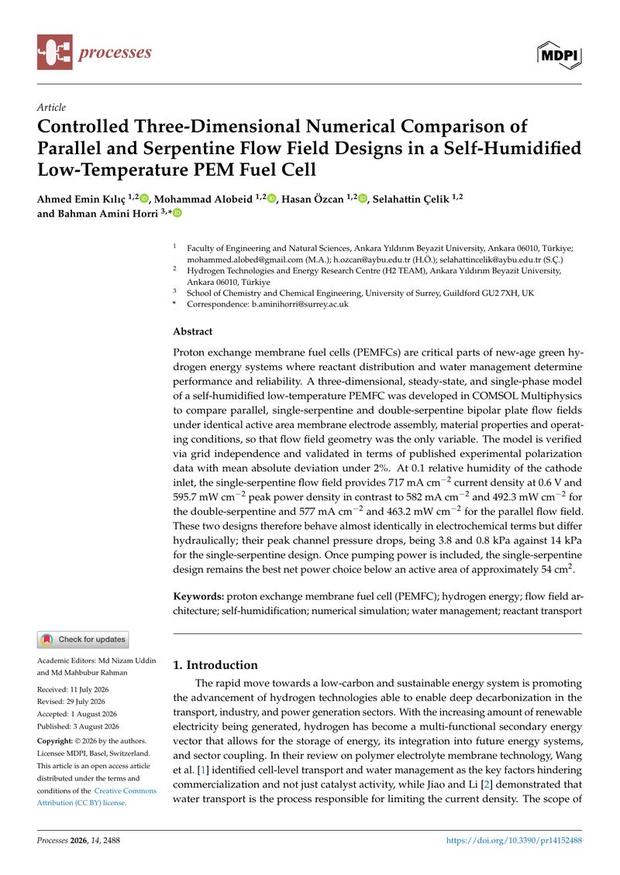
Processes, 2026, volume 14, article 2488
Controlled Three-Dimensional Numerical Comparison of Parallel and Serpentine Flow Field Designs in a Self-Humidified Low-Temperature PEM Fuel Cell
A three dimensional model built in COMSOL Multiphysics compares parallel, single serpentine and double serpentine bipolar plate flow fields under identical conditions, so that flow field geometry is the only variable.
-
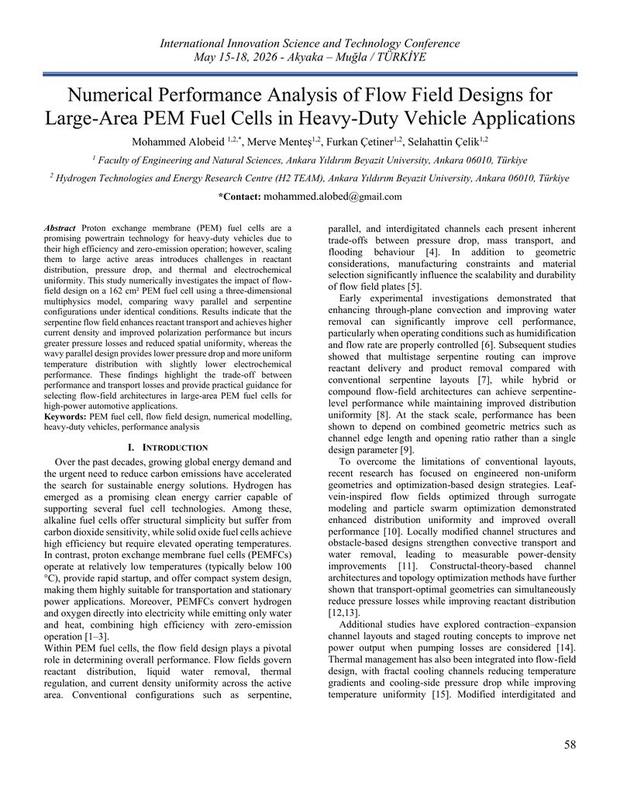
International Innovation Science and Technology Conference, May 2026, Akyaka, Muğla
Numerical Performance Analysis of Flow Field Designs for Large-Area PEM Fuel Cells in Heavy-Duty Vehicle Applications
A three dimensional multiphysics model of a 162 square centimetre cell compares wavy parallel and serpentine configurations under identical conditions.
No public link was supplied for this paper.
-
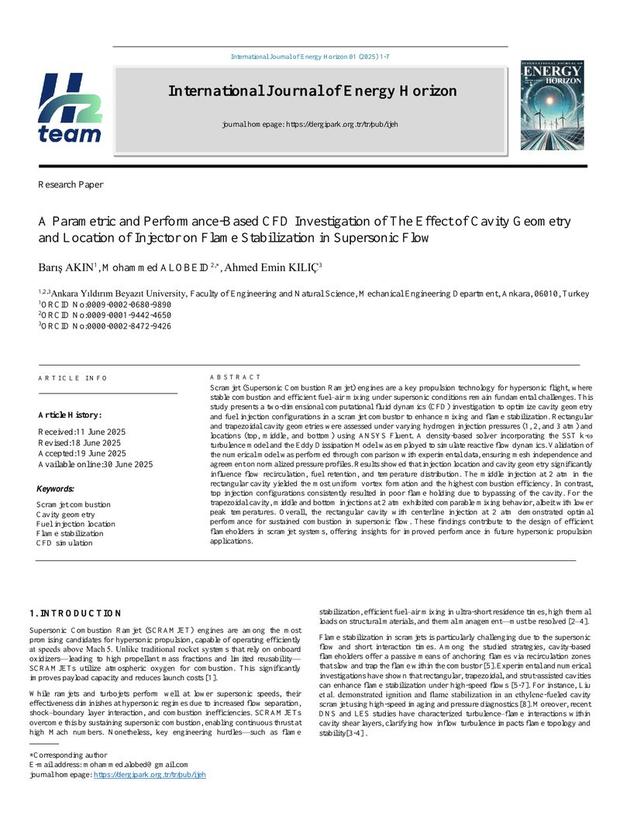
International Journal of Energy Horizon, 2025, volume 01, pages 1 to 7
A Parametric and Performance-Based CFD Investigation of The Effect of Cavity Geometry and Location of Injector on Flame Stabilization in Supersonic Flow
A two dimensional study in ANSYS Fluent of a scramjet combustor, testing rectangular and trapezoidal cavities against three hydrogen injection pressures and three injector positions.
-
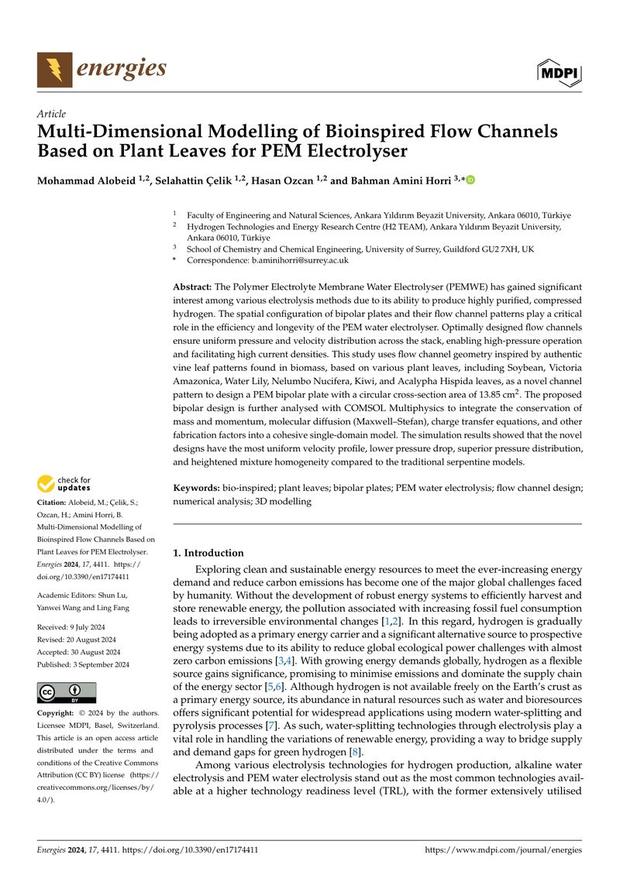
Energies, 2024, volume 17, article 4411
Multi-Dimensional Modelling of Bioinspired Flow Channels Based on Plant Leaves for PEM Electrolyser
Vein patterns from plant leaves are used as the channel pattern for a PEM bipolar plate, then analysed in COMSOL Multiphysics and compared with traditional serpentine models.
-
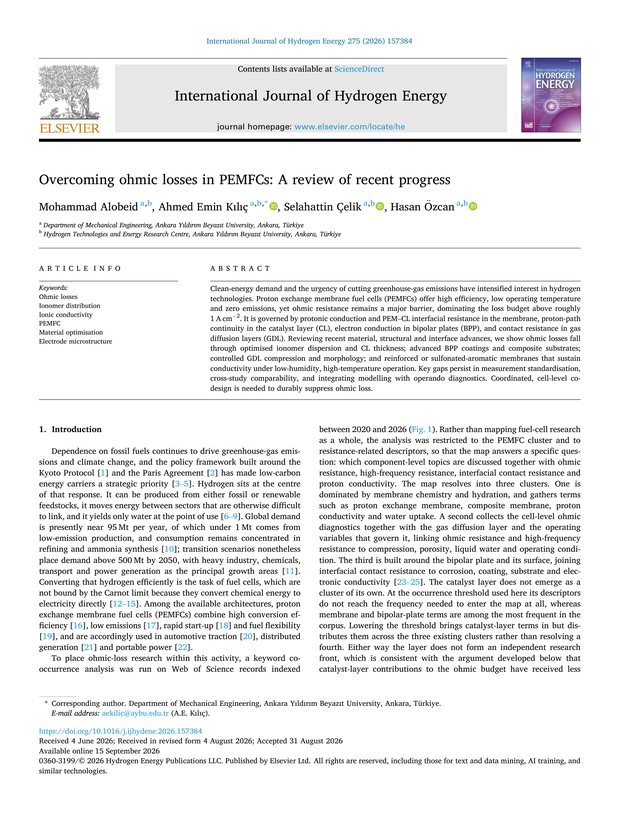
International Journal of Hydrogen Energy, 2026, volume 275, article 157384
Overcoming ohmic losses in PEMFCs: A review of recent progress
A review of recent progress in understanding and reducing ohmic losses in proton exchange membrane fuel cells.
-
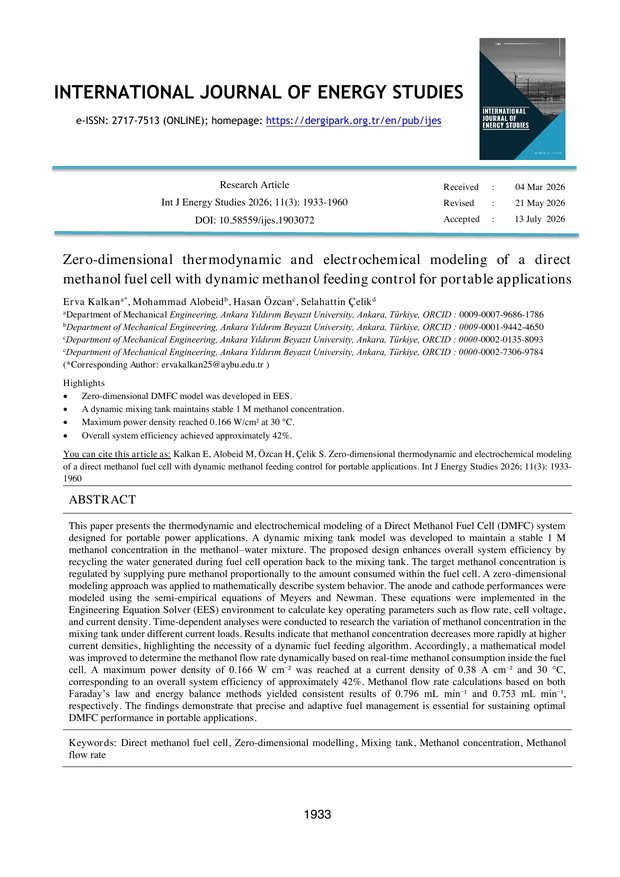
International Journal of Energy Studies, 2026, volume 11, issue 3, pages 1933 to 1960
Zero-dimensional thermodynamic and electrochemical modeling of a direct methanol fuel cell with dynamic methanol feeding control for portable applications
A zero-dimensional model built in EES describes a direct methanol fuel cell for portable power, with a mixing tank that keeps the methanol at 1 M by feeding fuel in step with what the cell consumes.
01 of 06
Titles, authors and publication details are reproduced from each article as published.
Dr. Mohammad Alobeid
Where hydrogen energy meets
computational modelling
- Mechanical engineer
- Hydrogen energy researcher
- Modelling & simulation consultant
CFD and multiphysics simulation, used to understand, develop and optimise complex electrochemical energy systems — and the same workflow you learn in the course.